
Summary
March was a strong month for Origin across products. ARM TVL reached new highs on both the stETH and eETH vaults, Origin Ether’s migration to compounding validators is underway, OUSD expanded capital allocations to Base, and OGN buybacks crossed 80 million tokens.
Here's a full breakdown of what happened in March.
ARM Performance and TVL Growth
March marked the first full month of public deposits for the eETH ARM, with TVL peaking at nearly $7M (3.2K ETH). The stETH ARM also reached an all-time high in ETH deposits, currently sitting at 7.6K ETH ($15.5M), with a trailing 30-day APY of 2.9%.
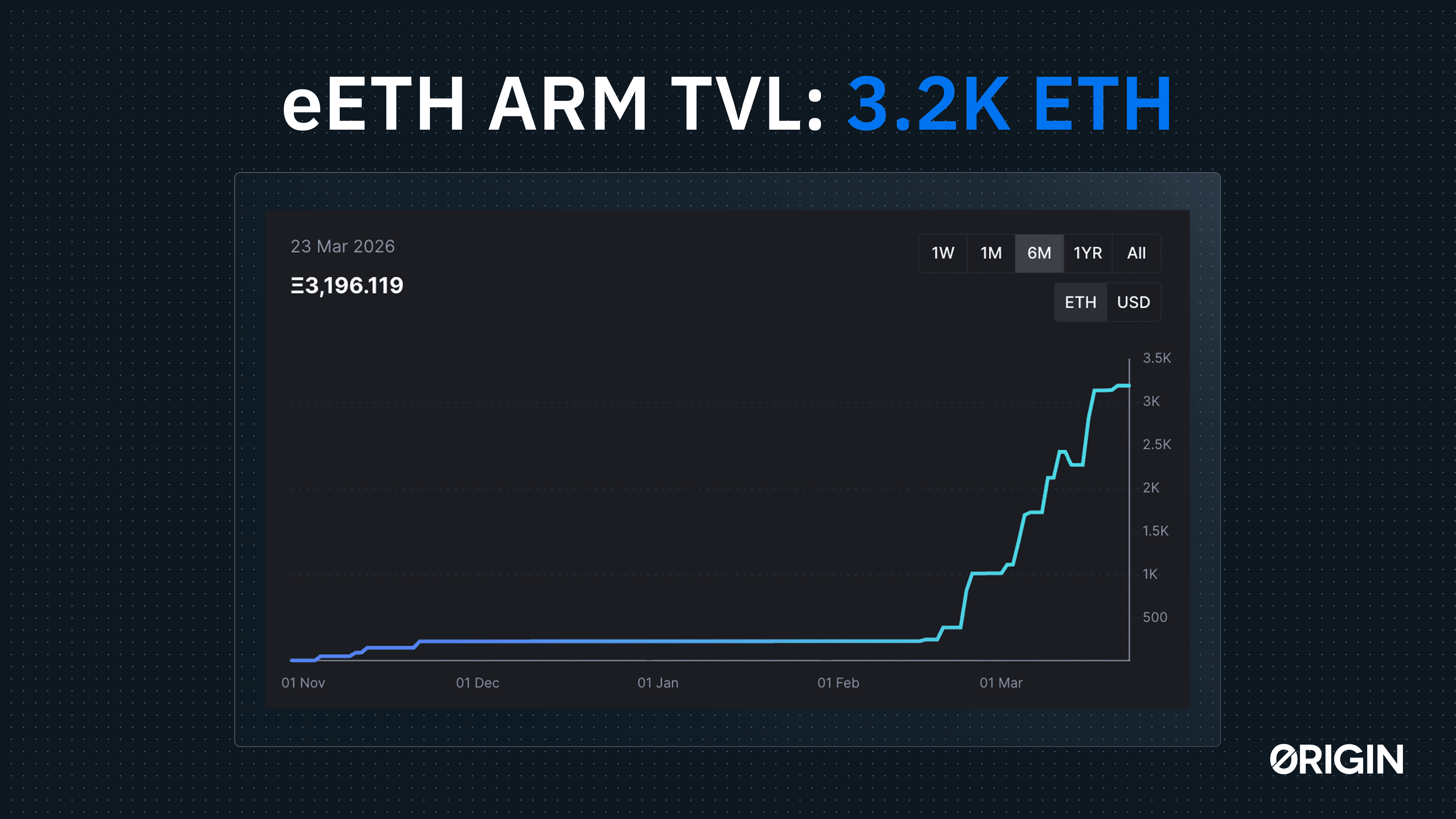
New ARM markets went live on Morpho last month, enabling leveraged ARM yield for the first time. Depositors can now borrow ETH against their stETH ARM and eETH ARM positions, opening looping opportunities through Morpho's non-custodial lending infrastructure.
Liquid staking markets were stable in March, but both ARMs continued to deliver meaningfully higher ETH yields than standard liquid staking rates. When volatility returns, wider spreads between AMM pricing and redemption queues will expand the arbitrage opportunity, translating directly into higher APYs for depositors.
OETH Migration to Compounding Validators
Origin Ether has begun migrating to compounding validators (0x02 withdrawal credentials), enabled by EIP-7251 introduced in Pectra. There is currently over 4.8K ETH in compounding validators, with the remaining 13.5K ETH in the process of migrating. Given current deposit queue times, the full transition is expected to complete by Q2 2026.
The upgrade changes how validator rewards are handled. Previously, rewards had to be periodically swept out of validator balances and redeployed. With 0x02 credentials, rewards accrue directly inside the validator and compound automatically, keeping capital productive without relying on intermediate contracts or manual redeployment cycles. Validators can also be topped up in smaller increments rather than requiring full 32 ETH deposits to activate new capacity, reducing idle capital as deposits scale.
Alongside this, OETH is among the first liquid staking tokens to adopt Merkle proof-based balance verification using EIP-4788, which exposes beacon block roots inside the EVM. This allows OETH to verify actual consensus-layer validator balances onchain, cryptographically, without relying on an oracle.
The result is a staking architecture with fewer operational dependencies, more predictable accounting, and a direct reduction in trust assumptions. It also contributes to Ethereum network health: compounding validators reduce total validator set size and lower P2P messaging overhead, supporting the network's long-term direction toward a more consolidated validator set.
Read the full breakdown: Origin Ether Is Migrating to Compounding Validators.
Origin Dollar (OUSD) Expands Allocations to Base
Morpho market lending APYs saw increased volatility in March following the Resolv USR exploit. OUSD had no direct exposure to USR, and all user funds remained protected throughout the incident.
In March, OUSD expanded its capital allocations to Base, deploying into high-liquidity, low-risk markets offering approximately 4.5% APY on USDC deposits. Over the trailing 30 days, OUSD has delivered 5% APY on average, outperforming leading yield-bearing stablecoins by ~100 basis points.
Origin also built a Morpho OUSD HyperLiquid Vault in March, preparing to begin allocating to low-risk Morpho markets on HyperLiquid. Initial markets will be WHYPE/USDC and kHYPE/USDC.
Origin Token (OGN): March 2026
Approximately 7 million OGN was bought back in March, bringing total cumulative buybacks past 84 million OGN which represents 12.5% of circulating supply. All buybacks fund staking rewards for xOGN holders, who are currently earning up to 14% APY. Nearly 50% of OGN's circulating supply is currently staked.
OGN saw a notable increase in trading volume in March, with 24-hour volume peaking above $160M.
Product Metrics
Here’s how Origin’s products performed in March:
- Origin Ether (OETH): achieved a trailing 30-day APY of 2.5% at $57M in TVL.
- Super OETH (superOETHb): achieved a trailing 30-day APY of 2.5% at $27M in TVL.
- Origin Dollar (OUSD): achieved a trailing 30-day APY of 5% at $5.8M in TVL.
- stETH ARM: achieved a trailing 30-day APY of 2.9% at $15.5M in TVL.
- eETH ARM: achieved a trailing 30-day APY of 2.8% at $4.9M in TVL.
In Case You Missed It
March saw OETH take a meaningful step forward in staking infrastructure, OUSD navigate a volatile lending environment, and both ARMs close the month at or near all-time highs in deposits.
In case you missed it, here are some of the key updates from March:
- Origin Ether Is Migrating to Compounding Validators
- OUSD x Base: OUSD Capital Allocation Expands to Base
- eETH ARM Hits All-Time High In Deposits
As always, we invite you to join our community on Discord and follow Origin Protocol on X for ongoing updates.
